
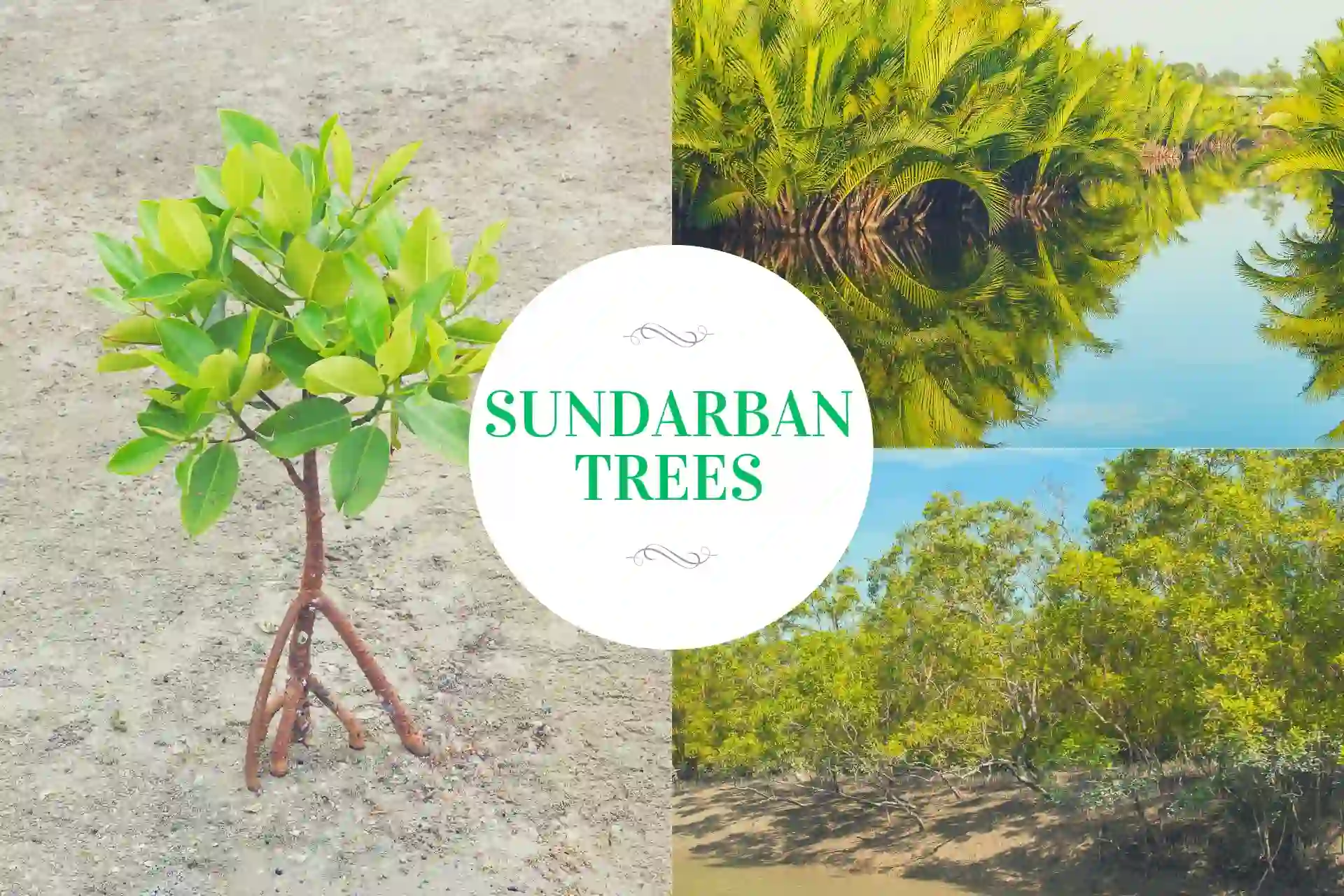
Sundarban Trees and Mangrove Forest 🌳
Overview of Sundarban Trees
The Sundarban trees form the world’s largest mangrove forest, home to over 80 plant species. From the iconic Sundari tree to Goran, Golpata, Hetal, and more, each tree tells a story of survival, beauty, and cultural importance, protecting millions while defining Bengal’s natural heritage.

Top 10 Trees in Sundarban
1. Sundari Tree (Heritiera fomes)
The Sundari tree in Sundarban is the pride of the forest, making up 70% of the eastern Sundarbans. Standing tall at 15–25 meters, Sundari trees are easily spotted during boat safaris. Their pneumatophores (breathing roots) rise above the mud, helping them survive in oxygen-poor soil.
Tourist insight: Guests often say they feel amazed when the guide shows how Sundari roots breathe underwater. 
2. Goran Tree (Ceriops decandra)
Known locally as Goran gachh, this tree thrives in high salinity zones of the western Sundarbans. Unlike the tall Sundari, Goran grows dense and bushy, often forming thickets where animals like wild boar hide.
Fun fact: Fishermen call some areas “Goran forest” because of how thickly they grow.
3. Gewa Tree (Excoecaria agallocha)
Called Gewa gachh in Bengali, this tree has a dark side — its milky latex is poisonous, earning it the name “Blind Your Eye” tree if it touches skin. Despite that, it plays an important ecological role in the forest.
Tourists often hear guides warning: “Don’t touch this tree’s sap.” 👀
4. Hetal Palm (Phoenix paludosa)
The Hetal tree is a palm with thorny stems, forming dense patches where tigers sometimes hide. Guests often recall their excitement when the guide says: “This is Hetal forest — a tiger may be watching us from here.” 🐅
5. Golpata Palm (Nypa fruticans)
Known as Golpata, this palm grows along canals. Villagers use its large leaves to make thatched roofs for mud houses. During boat tours, guests often see locals carrying bundles of Golpata leaves tied together — a simple example of how the forest sustains life.
6. Passur Tree (Xylocarpus mekongensis)
Passur, with its heavy timber, is one of the most valuable trees in Sundarban. It belongs to the mahogany family and is often spotted during safaris. The cannonball-like fruits of its relative, Dhundul (Xylocarpus granatum), also attract attention from visitors.
7. Keora Tree (Sonneratia apetala)
Keora, or Keora gachh, dominates the mangrove edge zones. Its fruits are edible, and during the monsoon season, villagers collect them for pickles. Keora roots rise like spikes from the mud, creating excellent photography opportunities for tourists. 📸
8. Hental Palm (Phoenix paludosa)
Similar to Hetal, Hental grows in slightly drier areas of the forest. Local villagers use its wood in fencing and house construction.
9. Garjan Tree (Rhizophora mucronata)
Garjan trees, with their stilt-like prop roots, look like living sculptures. Their tangled roots create natural barriers against storms, helping protect coastal cities like Kolkata from cyclones. 🌊
10. Bain Tree (Avicennia officinalis)
The Bain tree is a true salt-tolerant mangrove. Its leaves excrete salt crystals that sparkle in sunlight — a fascinating survival trick. Guests often enjoy touching its leaves and noticing the salty texture.
How Mangrove Trees Survive 🌱
Sundarban mangrove trees are nature’s engineers. They survive in tough conditions through:
Breathing roots (pneumatophores) – absorb oxygen in waterlogged soil.
Salt filters – roots block 90–95% of salt from entering.
Salt excretion – some trees push salt out through leaves.
Vivipary seeds – seeds germinate on the tree before falling into mud, ensuring survival.
Our guides often explain this during boat tours, and guests are amazed at how trees can “drink water but spit out salt.”
Traditional Uses and Cultural Importance
Sundari timber – used in boat building and strong house pillars.
Golpata leaves – roofing material for village homes.
Medicinal uses – Sundari bark traditionally used for treating diabetes and liver issues (supported by scientific studies).
Keora fruits – eaten raw or pickled by locals.
Threats and Conservation 🌍
Unfortunately, the Sundarban trees face serious threats:
Top-dying disease in Sundari trees (affecting 1.44 million m³ of wood).
Rising sea levels — 4 mm per year, drowning mangrove zones.
Deforestation — 37,000+ hectares lost between 2000–2017 Indian Sundarban.
Shrimp farming and human pressure destroying coastal patches.
But there is hope — the Forest Department has initiated mangrove plantations, and eco-tourism awareness helps locals value tree protection. 
FAQs About Sundarban Trees
Q1. What is the most famous tree in Sundarban?
The Sundari tree (Heritiera fomes) is the most famous and gave Sundarban its name.
Q2. How many trees are found in Sundarban?
There are 84 plant species, including 34 true mangrove species.
Q3. Which tree do tourists find most interesting?
Tourists often ask about Sundari, Hetal, and Golpata because of their beauty and cultural use.
Q4. Why are Sundarban trees important for Kolkata?
They act as natural shields against cyclones and floods, protecting millions of lives.
Q5. Can visitors see these trees during tours?
Yes, during boat safaris guides explain different trees like Sundari, Goran, Hetal, and Golpata.
Conclusion 🌿
The Sundarban trees are more than just plants — they are guardians of an ecosystem, protectors of coastal cities, and providers of life to villages. From the majestic Sundari to the humble Golpata, every tree has a role in shaping this living forest.
🌿 If you want to witness these incredible trees with your own eyes, join a Sundarban tour with Sundarban Mondal Travels. Our government-recognized MSME registered agency and expert guides will show you the hidden beauty of the mangrove forest, explaining each tree’s story during your safari.
👉 Book your Sundarban forest adventure today — and discover the magical trees that protect both wildlife and people.
Book Now

Baul song on sundarban tour
Home Baul Song on sundarban tour Baul Song on Sundarban Tour When you think of a Sundarban tour, the first things that come to mind are tigers, crocodiles, and the beauty of the mangrove forest. But hidden inside every trip is another magical experience that touches the heart – the

Sundarban Trees and Mangrove Forest
Home Sundarban Trees Sundarban Trees and Mangrove Forest 🌳 Overview of Sundarban Trees The Sundarban trees form the world’s largest mangrove forest, home to over 80 plant species. From the iconic Sundari tree to Goran, Golpata, Hetal, and more, each tree tells a story of survival, beauty, and cultural importance,